Unravelling the Roles of Recent Speciation and Trait Evolution in Shaping the Longitudinal Gradient of Tropical Reef Fish Diversity
mars 12, 2026· ,,,,·
0 min. de lecture
,,,,·
0 min. de lecture
Rémy LE GOFF
Théo Gaboriau
Camille Albouy
Loïc Pellissier
Fabien Leprieur
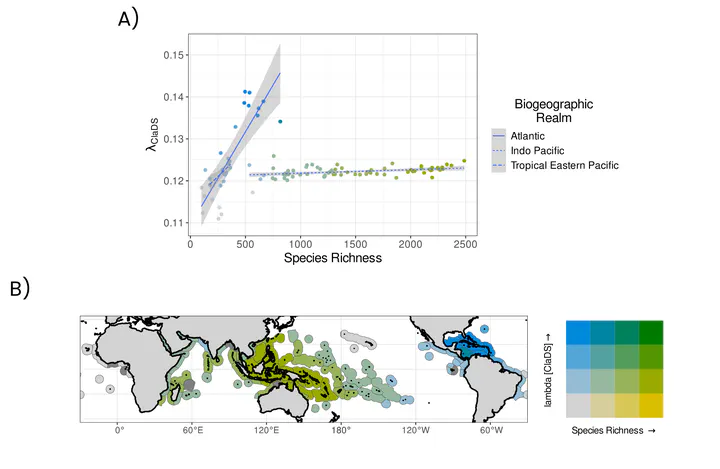 Figure from the paper
Résumé
Aim In the tropical marine realm, the increasing concentration of reef fish species toward the Indo-Australian Archipelago (IAA) has been extensively studied. The literature provides numerous biogeographical scenarios explaining this pronounced longitudinal diversity gradient. However, most proposed scenarios did not consider the interplay between recent speciation and trait evolution, nor the influence of diversity-dependent processes. Location Global and regional. Taxon Tropical reef fishes. Methods Based on a global data set on tropical reef fish distributions, combined with species traits (body size, trophic level and maximum depth range) and a comprehensive Actinopterygii phylogeny, we derived assemblage-level speciation rates across the world’s tropical marine ecoregions, as well as assemblage-level trait evolution rates. We then apply a causal modelling approach that simultaneously accounts for the potential influence of both current and past environmental conditions on rates of recent speciation and trait evolution, and ultimately, on species richness distribution. Results Our results reveal gradients in speciation rates and trait evolution rates that do not match the spatial distribution of species richness. Compared to other regions, the species-rich IAA did not exhibit higher rates of either recent speciation or trait evolution. In contrast, the Caribbean region exhibited the greatest rates of recent speciation, but this pattern was uniquely driven by the recent radiation of hamlets (Hypoplectrus spp.). Caribbean and southwestern Atlantic reefs were also shown to harbour species with, on average, faster recent evolution in body size and maximum depth. Finally, regardless of the biogeographic realm considered (Indo-Pacific, Atlantic or Tropical Eastern Pacific), species richness was found to strongly constrain trait evolutionary rates related to trophic level. Main Conclusions Overall, our findings suggest that the longitudinal gradient in tropical reef fish diversity is unrelated to either recent speciation or recent trait evolution, and that the IAA no longer functions as a centre of origination for tropical reef fishes. Our results also suggest that diversity-dependent mechanisms may have played a key role in shaping biogeographic patterns of recent evolution of trophic level in tropical reef fishes.
Type
Publication
Journal Of Biogeography